Thursday, November 3

Christchurch to Kaikoura

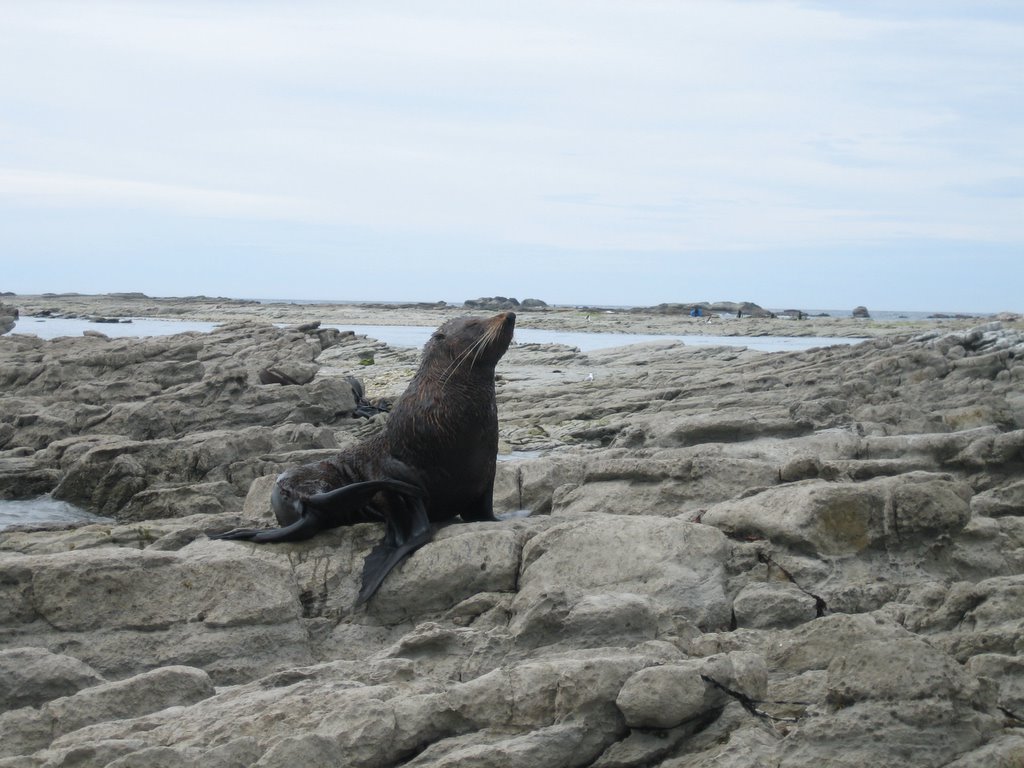
A seal at the colony at Kaiakoura -click on the photo to enlarge.

Today we travelled to Kaikoura which means in Maori means Food Crayfish. EGG KAI =Food and KOURA =Crayfish.

We were struck by the unusual landscape, different to the rest of New Zealand as snow clad mountains meet up directly with seashore. Kiakoura is on a peninsular that juts out into the Pacific Ocean from the 2600 metre high Kiakoura Mountain Ranges.

Around Kaikoura are the remnants of 15 individual fortresses and lookouts, set up by the Maori tribes and evidencing fierce battles against invaders hoping to gain a foothold in this settlement as Moa numbers declined elsewhere. That's what the local museum said.

To day its a popular holiday resort and a world famous as a feeding ground for those gentle giants of the deep, what must be the grandest creatures on earth, the giant sperm whales. They had nearly been hunted to extinction, but whether they now survive the fresh hazards of ocean pollution I guess is unknown. We were booked to go whale watching but unfortunately the seas were too rough, better luck I hope tomorrow !! click here to view whalewatch

To day we did sight fur seals, unconcerned and just metres from us.

Wednesday, November 2

Christchurch continued

To day we visited the Botanical Gardens, the Art Gallery; re visited the Museum and finally saw the New Zealand Kiwi, which is a flightless bird and icon to New Zealand.

The Botanical Gardens are 75 acres of picturess flowers, trees and Cambridge Punts (gondoliers) who take visitors along the smallish Avon River alongside the gardens.

The new art gallery houses 5,500 individual displays and is one of the largest collections of NZ art in the country. Completed in 2003, it's modernistic in design. Click here to view.

The Kiwi bird is an icon to NZ, appearing on its coins, regimental badges and internationally as Kiwi shoe polish. The Kiwi is a flightless bird that forages in the forest and its numbers have been decimated by introduced species that eat its eggs and by loss of its habitat. A breeding program is underway. If your interested in finding out more about the Kiwi Click Here.

Tuesday, November 1

Christchurch

Click on the photo to enlarge.

We spent the day visiting the Cathedral and the Museum.
Christchurch was named by its founding fathers, after Christchurch in Oxford, from where they came. It’s an easy city to visit, very English in its architecture and style but using local stone materials. We went on tour of the Cathedral, climbing the narrow staircase to the bell ringing tower and turret. Very impressive.

The history of the Maoris’ makes mention of their wars over territorial rights and cannibalism. I think there position pre colonization may also have been effected by other important factors, primarily arising from the depletion of their food supply. History confirms they hunted the Moa to extinction through burning of their forest inhabitant. Populations would have relied upon that source of food and of the forest bird life. Extinction would have had a devastating effect and I think the population would not have been sustainable. It’s likely I think the subsequent wars and cannibalization were driven by an ultimate fight for survival. Their history is an oral one, yet there seems no oral history of warfare when the Moa was hunted.
It’s not surprising various tribes formed allegiances with the British in the Mauri Wars, fighting against other tribes. Theses disputers were no doubt due to other factors as well, but I believe the first wars are more likely you have arose as consequence of the reduction in their sustainability, brought about by the depletion of their primary food source.

Monday, October 31

Greymouth to Christchurch

To day we travelled to Greymouth and then on to Christchurch on the Tranz Alpine train.

Greymouth is known for its coal mining, that became the "black gold" after gold mining returns dwindled. The journey by train was a steady climb through the wilderness to Arthurs Pass at over 700 metres and slowly down to the Canterberry plains. A memorable journey of 4.5 hours involving 16 tunnels, with spectacular scenery.

Whale Rider

Whilst staying in Franz Josef we watched a video entitled “Whale Rider”, based upon the novel by renowned Maori writer Witi Ibimaera. The film wren released won several awards. Click here to learn more about this remarkable writer.

Its a delightful tale of mysticism and Maori culture set in a small New Zealand coastal village, where the Maori claim descent from a Whale rider. The Maori tradition is the first born son of the chief succeeds to that rank as would his first born and so on. When twins are born and the boy twin dies prematurely the chief will not accept his granddaughter as a future leader. Tribal misfortunate are then attributed to his granddaughter, but despite the hostility, his granddaughter remains compassionate towards her grandfather, as she realizes she is confronted with 1,000 years of tradition.

The film is cotemporary story of love and tribal customs and ultimately the young girl’s courage triumphs as she rescues her tribe form a possible apocalyptic end, in a scene connected with the beaching of whales. The acting of the young girl is simply stunning and it’s a riveting tale.

Sunday, October 30

Maori Culture

It has been estimated the Maori's first came to New Zealand about 1,000 years ago. They would have visited in their giant ocean canoe's, and its not clear exactly where they came from, possibly somewhere in the Polynesian area, like Tahiti and or the Cook Islands, but thee would certainly have brought their rich culture with them. They quickly prospered and as these lands were previously uninhabited their principle source of food, the giant flightless bird called the Moa, was easy prey, and hunted to eventual extinction. The Mao stood over 9 feet and weighed 240Kg. The Moa inhabited the forest, so the Maori undertook extensive burning to drive out their quarry into the open for the hunters. Thus with a high protein diet Maori numbers expanded, mainly in the North Island, and to a less extent in the South Island.

They were fearsome warriors and wars broke out, mainly over territorial rights connected to the land. Later with the British there were wars that eventually led to the signing of the treaty of Waitangi, between the chiefs of New Zealand and the Queen of England. What it actually means remains unclear and it is the subject of on going negotiation.

Their culture is rich and they believe in a Earth Mother and Sky Father who bore a multitude of children who were confined to their parents bodies in total darkness.
Eventually the children rebelled and forced their parent's apart, creating a new "light" that subsequent generations enjoy. These first born children became the Gods of the Polynesians and one called "Tane" is the god of the Forest. The strength of Tane is embodied in the trees and they believed if too many trees were cut down that darkness would fall upon the Land.

The 2 original parents, the God of Earth and Sky show eternal love for all, evidenced by the tears of rain and dew of the sky god and the mists of the earth god. They lay to together in a timeless embrace of love.

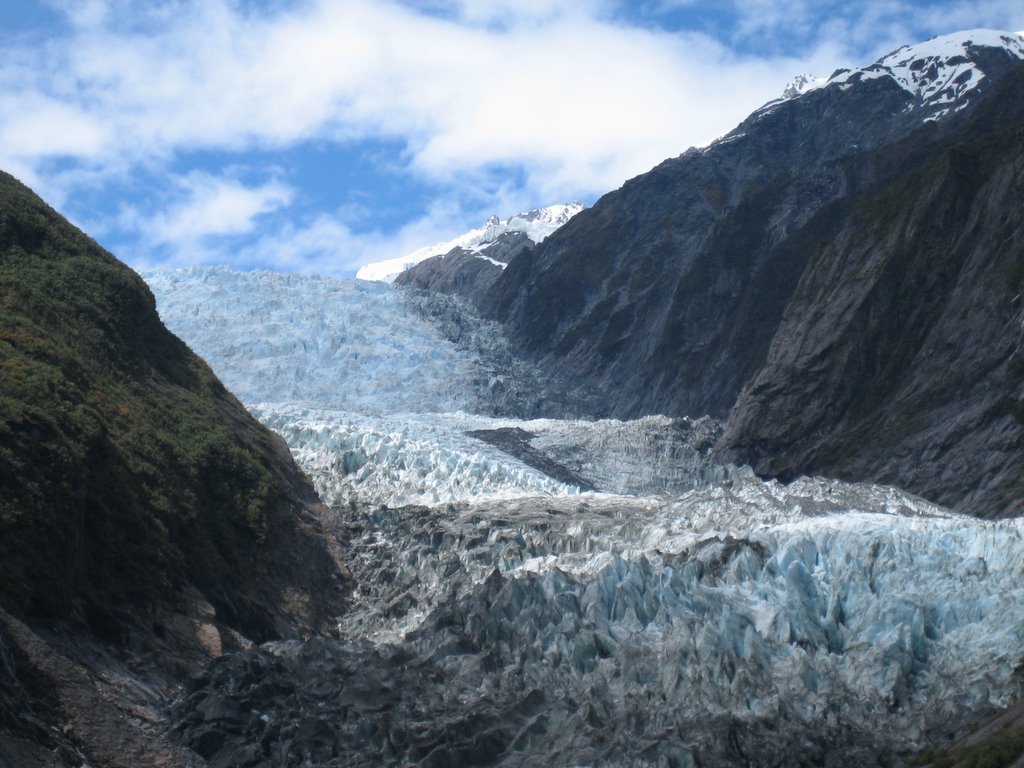
Franz Joseph Glacier

Click on the photo to enlarge.

To day we are at Franz Josef. click here to view.
We travelled from Queenstown in a North Westerly direction, entering the region known as the Westland National Park, another World Heritage Listing area.

Currently we are staying in the township named after the Glacier. Behind us is a range of mountain peaks, including Mt Cook, the highest mountain in New Zealand at over 3000 metres. Consequently, within these conditions, a huge volume of snow is dumped on the upper slopes and the Franz Josef Glacier is one of 140 within the parkland. To day we went on a magnificent walk to view this mighty glacier. During the walk it was interesting to note just how far the glacier has retreated, attributed to global warming and despite minor advances from time to time with increased snow fall.

Friday, October 28

Te Anau Glowworm Caves

To day we traveled to Te Anau and then by boat to the Te Anau Glowworm caves.
Click here for a link.

Glowworms I think are native only to Australia and NZ, appearing like tiny strands of wire, the lenth of a matchstick, hanging from cave walls. A chemical reaction in their stomachs produces a light, becoming brighter as they become hungrier. Insects attracted to the light become their food.

You enter the cave by foot and then proceed for most of the journey by boat.

Your senses are completely overwhelmed, from pitch blackness and silence (no talking is permitted which would frighten the glowworms) to illumination revealing cathedrals and a roar from underground streams cascading down the rocky crevices beside you.

Its like entering a mysterious underground world of weird rock formations, waterfalls and illuminated cathedrals.

Thursday, October 27

Queenstown


Click on the photos to enlarge.

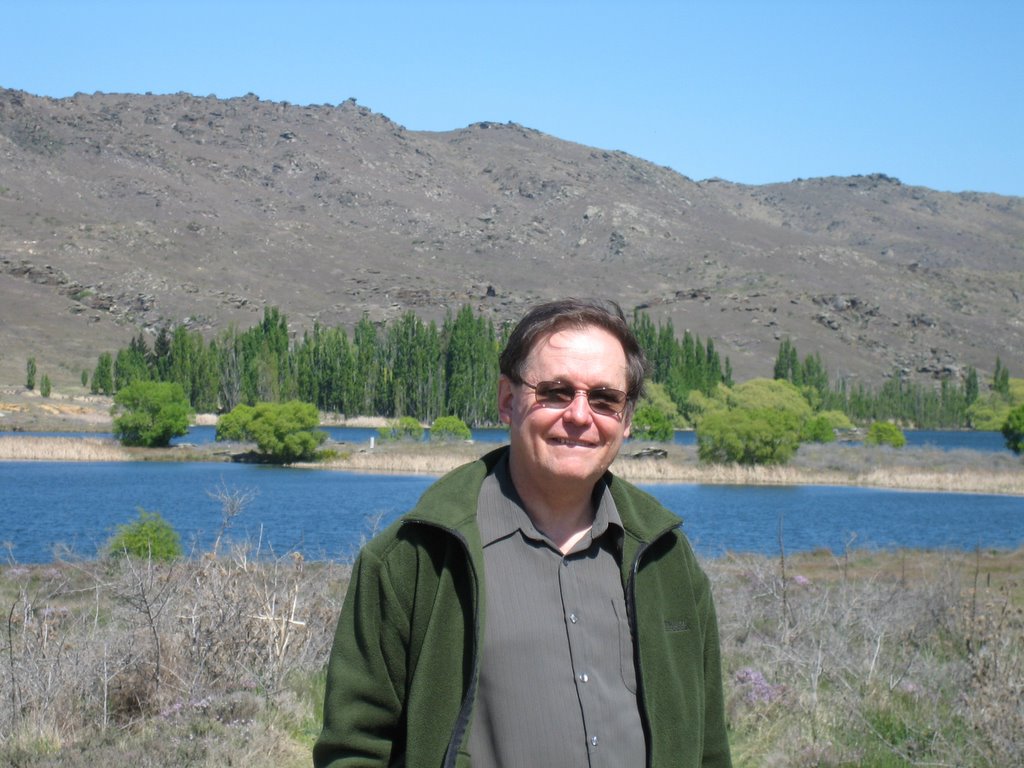
A view from our window of where we are continuing our stay in Queenstown and our hotel situated in Reese Street is named ater its Scottish founder who established sheep farming in 1860. Not long afterwards he was paid 10,000 pounds compensation for part acquisition of his land for gold exploration. Gold was discovered in the Shotover river in 1862, bringing thousands of men and some colorful women to converge on the settlement. The Shotover river is the second highest gold bearing river in history, second only to Klondike in Northern Canada. The River yielded 57.6 Kgs of gold per day in its early days.

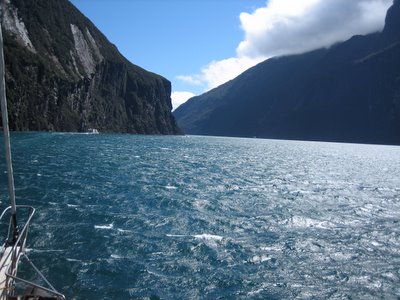
Today we went on a long day trip to Milford Sound. Click here to view the area. The fiord at Milford was formed by a giant glacier over 1,000 metres in height that carved out its current day shape meeting up with the Tasman ocean. Its mode is one of teeming rain and high winds. Rainfall is 30 feet a year and winds can reach 160kmh but we were fortunate to experience a beautiful day and only temporary brisk winds of 40 knot's. The second picture is view from the boat.


Our journey to MIlford took in lush farming land, mainly sheep (there are 40 million NZ) and deer, ostrich and fishing. Like most areas NZ suffers from imported species and havoc is inflicted by Stoats (from the weasel family) and Possums.The Stoats devour the flightless birds and the possums rare vegetation.

Driving through the foirdland we encountered towering mountains and green remote valleys, a true wildnerness area.

Upon arrival at Milford we boarded our ship and on our cruise encountered penguins and seals sunning themselves on the rocky outcrops below the towering cliff faces of the snow clad mountains. The views along the way were stunning and those within the fiord breathtaking.

Tuesday, October 25

Dunedin to Queenstown


To day we set off from Dunedin to Queenstown traveling in a north westerly direction.

Our first stop for lunch was at the small township of Lawrence where gold was first discovered in 1861. The first settlers established large sheep runs but is wasn't until Gabriel Read made a gold discovery that the region blossomed and the township expanded temporarily to over 11,000.

As we journeyed on the scenery changed to reflect more arid features of rugged craggy barren mountain peaks.

It is of interest to learn during the gold maning boom, just as what happened in Australia around the same time, the country became a haven for Chinese immigrants escaping the "Opium Wars " and unrest of their homeland. However their arrival was not welcomed and they suffered at the hands of the local diggers despite only prospecting discarded pickings. Such was the hostility to the Chinese they were forced to erect shelters amongst the rocky outcrops and amongst the boulders so they were difficult to see and access.

We arrived in Queenstown and were immeadiately struck by its beauty, surrounded by the mountains with snow capped peaks and nestled on the shores of the mighty Lake Wakatpu.