Australia’s surging population more than doubled over the past 50 years fuelled by successive waves of immigration and natural increase accelerating in more recent times. Should the growth spurt continue we may triple in size over the next 50 years; prompting political parties to debate sustainable population levels and the wisdom of continued high immigration levels. Immigration has been the catalyst for growth which has transformed our nation to formally adopt multiculturism as successive waves of immigrants have enriched our culture, whilst creating a diverse range of fledgling new enterprises. But due to poor planning Australia is also experiencing cracks in our infrastructure and a chronic housing shortage. As house prices plummet elsewhere Australia’s average price increase last year in many areas was around 33%, but one day the bubble will burst.
Appropriate Immigration appropriate to sustainable population levels is a complex issue as different conditions apply to the regions. Regional centres mostly can accommodate more people but lack essential infrastructure and skilled employment opportunities which are more evident in our big cities. Overall, Australia is one of the most highly urbanised countries in the world as our large cities of Brisbane, Sydney and Melbourne make up nearly 70% or the population all huddled along a narrow land strip on the eastern seaboard.
The two sides to the argument are as follows: those in favour of continued high immigration levels on the basis immigration creates the wealth to underpin living standards, education, productivity and provides the growth to absorb higher health spending on an ageing population; versus those against who either maintain we already exceed sustainable population levels or face that imminent risk. The weaknessess in the popular view we can easily accommodate a much bigger population because we only inhabit a tiny fraction of this vast fragile land mass is abundantly evident in our depleted landscape. Prolonged droughts, salination, severe erosion and a bio diversity depletion where species extinctions exceed levels seen anywhere else in the world all point to over-use and a lack of sustainability.
Hence If we define sustainability as a system able to achieve self perpetuation and adaptation in perpetuity then clearly we have already exceeded that point. But as is often the case the quality of any discussion is predicated on asking the right questions, since the carrying capacity to support a given population level in turn reflects a multitude of factors, not least of which are our material dependency and lifestyle choices. Once you begin debating the economics of policies designed to foster more development and housing into the more sparsely populated regional and country areas, away from the burgeoning cities to accommodate more migrants, you assume the same post-war optimistic material mind-set that presided over our current lack of sustainability. Rather I think a more thoughtful approach might be to pose the question ‘How can Australia provide a sustainable home for many more immigrants for us to share our vast land and resources. ?
Overpopulation in a fragile country like Australia is not defined by population density, but by the extent sustainable resources can meet our needs, coupled by a heavy transport reliance to move essential goods and services over vast distances. However, when we talk about people’s needs we immediately run into road blocks, since what is considered a basic human need in one country is a luxury for others living literally on our doorstep with struggling economies, which means mostly they are far worse off. Can we stand by based upon our sovereign rights and demand that all of those needs are to be met before we can widen our doors to willingly share in our resources with others who are far less well off ?.
Naturally enough people conclude their basic needs are denied in times of high unemployment and where there is a large disparity in income. It is also true that sudden dislocation to an economy can have unintended disastrous effects given investments in infrastructure take a long time to build, and any strategies to exit unsustainable development requires consideration for alternatives for those adversely effected. But at the consumer and business level there are many choices we make which are adding to the problem. House sizes have doubled on average over the past 30 years while the average level of occupants have halved. This example is typical of excessive consumerism since the larger homes all need more furniture and entertainment rooms full of elaborate equipment to use more power, water and gas, which provides enormous scope for savings should we revert to more sensible sizing.
Returning to the question 'How can Australia provide a sustainable home for many more immigrants for us to share our vast land and resources?'; it is apparent a larger population can only be sustained by significantly reducing our per capita use of resources. Business will also be helpful as competency improves in accounting for the cost of carbon to preference investments in the new cleaner alternatives, which all require a much higher investment in human capital. Those dirty industries such as coal currently crowd out land that could otherwise be used for agriculture.
Presently there are nearly 100,000 job vacancies in the rural sector.
Paradoxically it is the very idea of growth as such which prevents us from achieving it. In other words by learning from the past mistakes and assessing the present opportunities we can plan a future to include a sizeable migrant intake and also achieve a more sustainable future. But that won’t happen unless there are significant changes in lifestyle and attitude.
Here are a few snippets that may be interest.
Australia's agriculture sector needs an additional 96,000 full-time workers and 10,000 part-time workers.
According to the Sydney Morning Herald in an article headed as per above on the 17th August 2010, the Australian Farm Institute reported that if the sector continues on a business-as-usual course the shortage will worsen, driving up labour costs and limiting future growth in the sector.
Executive director Mick Keogh said agriculture was competing with mining for regional workers, and he believed there was a generally poor perception of the farming sector among school leavers.
Sustainable business practices
Already sustainable business practices is a keyword to Business, Government and in the Not-for-Profit sector as organisations realise the competitive advantage of having an integrated approach to sustainability to reduce their carbon footprint within their operations. Today Business shares those objectives with employees, clients, stakeholders and the communities in which they operate.
It has now become an integral core of the reporting for all public companies in Australia.
Business expects a tax on carbon and is acting as if it is inevitable rather than waiting for government action.
Buying back water for the environment
There is consideration being given to purchase Cubbie’s water licensees under the government’s $3.1 billion program to buy back water for the environment. Cubbie has more water than Sydney Harbour. The water was previously used for cotton crops prior to Cubbie entering into receivership but could be used for other crops that require far less water. The outcome will not be known until after the election.
Food and groceries
The local industry is aiming to achieve an enhanced system to ensure sustainability, to address environmental concerns and remove inefficiencies which will achieve lower costs. Accurate food labelling is now a permanent feature for consumers and the industry is particularly concerned about the impact of deforestation in the South East Asian region and supports the development of certified sustainable palm oil.
Recycling
Most replacements for ageing equipment today can save up to 80% in energy use and in many instances are 97 % recyclable. Domestic recycling in Australia is well below optimal levels. It's up to us the consumers of this country to ensure all of the recycling programs are working well. That means accurately sorting the items into the various coloured bins so that recyclables don’t finish up in landfills. So far the news is good with a reported steady increase in materials recovered for recycling.
But the big test is to learn to live with less.
Housing and transport.
Maintaining a house is expensive when you think about painting, roofs, bathrooms, kitchens, gutters, lawns, hot water systems, drains and so forth but If you have half the size and half the land you eliminate half the headache. We seriously need to downsize in Australia and the same is true in relation to our transport. People have tended to regard their homes as investments rather than simply as places to live and bring up a family as the case may be.
Friday, August 20


Sunday, August 1
Old Caltex storage site at Balmain redeveloped


Once this area was a Caltex fuel storage facility close to the city of Sydney at Balmain. The area has now been redeveloped into a picturesque park overlooking the Harbour.

Thursday, July 15
All the efforts of the human mind cannot exhaust the essence of a single fly.
Introduction
I remain mindful of the words of one of the great religious philosopher Thomas Aquinas who said ‘All the efforts of the human mind cannot exhaust the essence of a single fly'.
His quote reminds one of our limitations and need for humility. His philosophical style was to argue the for and against before concluding and avoid bold statements based purely on religious texts. Instead, he recommended any relevant scientific or specific knowledge about a subject be studied beforehand as otherwise one risked making a fool of oneself and losing credibility.
Aquinas’ philosophy coincided with the early beginnings of modern day science when all philosophy was based upon science. Interestingly enough it is only in more recent times as the volume of scientific knowledge expanded exponentially that we seek to separate the two.
My intention is to attempt to perpetuate the rather grand tradition of this sage by examining the religious philosophical implications of modern day science and to see how they challenge or reinforce our traditional views, beginning with the basics of Einstein’s special theory of relativity and concluding with the quantum mystery.
An introduction to the special theory of relativity.
Imagine you’re on a spacecraft and another spacecraft passes you speeding away at the difference in your respective speeds. But that relative increase in speed will not be true in respect to a laser launched from a nearby space station as that laser flashes past you at the speed of light. Despite accelerating the speed of your spaceship you notice you can make no impression on the speed at which the laser pulls away from you at an indicated speed of light. Puzzled you retry the experiment to soon realize the laser always disappears from view at the speed of light regardless of your spacecraft’s speed.
If you able to understand the reason for this then you can understand the special theory of relativity.
Einstein correctly concluded that since nothing can exceed the speed of light all of our motions through space will be relative to that absolute, so that any observations of the speed of light will be the same wherever you are. Hence the speed of the laser will always be observed at travelling at the speed of light.
We are all familiar with the concept of a game of table tennis noting it takes the same time for the ball to pass over the net when playing a game in a fast moving train as it does for a game played on the platform. If you carried out an experiment measuring electromagnetic waves you would get the same result.
However for an observer on the station looking into the fast moving train this is not the case since the trains speed plus the speed of the ball will equal the total speed of the ball as far he is concerned. The actual speed of the ball is the same for all observers but it is relative to motion whilst light for any observer anywhere will always only be seen as the same absolute speed of light.
Hence all of the laws of science are the same to all observers regardless of their location in space after allowing for gravitational effects.
Einstein’ discovery paved the way for this conclusion (which however will be challenged later on) and hence our observations are relative to our motion through space except for the combination of space and time termed space-time. After discovering the special theory of relativity Einstein incorporated the gravitational field effects which cause warping within his general theory of relativity.
A brief excursion into the slippery concept of time differences.
The obvious conclusion following on from the theory of special relativity is that any movement through space reduces our time in space to the point theoretically once you have reached the absolute speed of light time becomes frozen.
Time + motion through space = speed of light.
Therefore if motion is represented by the speed of light then time must equal zero
This idea of course in reality is quite farcical since any object travelling through space at that speed would develop such an unimaginative amount of mass as would be almost the equivalent of all matter already present in the entire universe.
However there is a relative difference for all of us depending on our motion through space but the miniscule differences on planet earth can effectively be ignored and we can feel comfortable with our outdated Newtonian view of time. We can have no doubt however as to the soundness of the theory since it is has been independently verified by extremely accurate atomic clocks stationed on board aircraft. Spend your entire life flying in planes and you will be younger than your comparable walker but the differences are so small that on your death bed the flyer would scarcely have the additional time to think about even saying a few ‘Hail Mary’s’.
However in the vast distances of space the effects can be calculated to show huge disparities.
Returning to our spacecraft to imagine in the future we have discovered a way to travel at close to the speed of light to find some remarkable consequences. Since our motion at close to the speed of light drastically reduces our time in space any prolonged space journey lasting a number of years will require us to wind forward our clocks hundreds of thousands of years on reentry into planet earth.
But our stay at home earthlings have long since perished as those who welcome us home are thousands of generations later than those present when we left. That is because time has not slowed for them as it has for the space travelers whilst the biological aging is no different for either group.
Spacecraft intrepid travelers slow space time is only point one ( .1) with motion at 99.9.
Whilst for the stay at home earthlings earth time is 99.8 plus with motion at point two (.2)
These are simply arbitrary numbers I have chosen to help illustrate my point.
Can we draw any religious philosophical conclusions?
Since the universe is subject to unique laws which unfolded miraculously in exact sequences to allow life to form one can posit that we are the product of a creation in an evolving mystery which I think can only leave us in state of wonderment.
For me there is abundant evidence around us everywhere to indicate that all life and nature itself is simply miraculous. By virtue of the laws of science we can also say we live in the most probable of many possible universes which leads us to reasonably suggest within those predestined routes there only exists causality for freedom of thought or actions or choice. That causality I see as an evolved creation gift which gives us the sense of freedom or free will within the determinism arising from constraints of those predetermined laws.
Although we can measure time we cannot say what it is and can only understand time by combining time with space for the absolute concept of space-time. Accepting for the moment a creator then past present or future becomes irrelevant accepting that for us we remain trapped within what seems to be to us our enclosed universe where time does seem to be indicative of an arrow usually always moving forward except for possibilities inherent in extreme warping effects of gravity.
But so far we have only barely scratched the surface to already reveal our rather tenuous grip on reality and of time.
Understanding classical physics through the application of the quantum
So far we have viewed the universe through the prism of classical physics which can confidently predict planetary movements and space travel to such a degree that we can have confidence in these evidence based outcomes. But if we attempt to understand classical physics through the applications of the quantum (the subatomic level of particles present in the universe) you expose those universal laws to some doubt. Indeed the general theory of relativity which has been demonstrated to be proven correct over time is only valid as it applies to large physical objects but only barely clings on to its integrity when you begin to contemplate the bizarre behaviors of the smallest of those fragile tiny particles known within our universe.
Einstein’s explanation for quantum mechanics ( the probabilities and uncertainties of sub atomic particles known as quantum laws ) where particles split into respective waves or particles to mimic behaviors as if they were still one, regardless of their distances apart, was to say those correlations were due to the underlying properties already inherent in both prior and after disentanglement. In other words these 'spin characteristics ' were integral to the separated particle and its wave function before and after they became separated.
Once again Einstein’s elegant theory seemed plausible enough but other physicists were doubtful. The matter was settled once and for all when Einstein and other brilliant physicists that followed him were all proven to be wrong half a century later. There is now overwhelming evidence for this so called quantum entanglement. (See Brian Greene – 'The Fabric of the Cosmos – Space, time, and the texture of reality').
Conclusion
The search for answers goes on with scientists now entertaining the idea of different dimensions and hidden properties within those minute particles that might provide solutions to the seemingly intractable mysteries. If you believe knowledge is reality (which can’t be proven or disproven) it could be we simply do not have sufficient knowledge about the particles since that knowledge is hidden within another dimension upon which we are not privy. Suffice to say that space may be not as we thought it was but possibly is made up of many more dimensions.
Should any of these extra dimensional theories turn out to be correct it will confirm that at the most fundamental level we do not experience the reality that underpins the universe.
In that sense we can return finally to a religious philosophical view and conclude that hardnosed materialistic evidence based science is now leading us to the view there is a reality beyond all human experience and understanding which may well always be the case. So that trust which is so important in our relationships with others, but so often can be misplaced, is also analogous to the universe, since human experience is not always a good barometer in understanding her rich fabric, bearing in mind - ‘ All the efforts of the human mind cannot exhaust the essence of a single fly.’
So that all we can do is to have trust in the human spirit and for those who have a religious leaning, an ultimate trust - we need not fear our morality for in death we return home from whence we came.
I remain mindful of the words of one of the great religious philosopher Thomas Aquinas who said ‘All the efforts of the human mind cannot exhaust the essence of a single fly'.
His quote reminds one of our limitations and need for humility. His philosophical style was to argue the for and against before concluding and avoid bold statements based purely on religious texts. Instead, he recommended any relevant scientific or specific knowledge about a subject be studied beforehand as otherwise one risked making a fool of oneself and losing credibility.
Aquinas’ philosophy coincided with the early beginnings of modern day science when all philosophy was based upon science. Interestingly enough it is only in more recent times as the volume of scientific knowledge expanded exponentially that we seek to separate the two.
My intention is to attempt to perpetuate the rather grand tradition of this sage by examining the religious philosophical implications of modern day science and to see how they challenge or reinforce our traditional views, beginning with the basics of Einstein’s special theory of relativity and concluding with the quantum mystery.
An introduction to the special theory of relativity.
Imagine you’re on a spacecraft and another spacecraft passes you speeding away at the difference in your respective speeds. But that relative increase in speed will not be true in respect to a laser launched from a nearby space station as that laser flashes past you at the speed of light. Despite accelerating the speed of your spaceship you notice you can make no impression on the speed at which the laser pulls away from you at an indicated speed of light. Puzzled you retry the experiment to soon realize the laser always disappears from view at the speed of light regardless of your spacecraft’s speed.
If you able to understand the reason for this then you can understand the special theory of relativity.
Einstein correctly concluded that since nothing can exceed the speed of light all of our motions through space will be relative to that absolute, so that any observations of the speed of light will be the same wherever you are. Hence the speed of the laser will always be observed at travelling at the speed of light.
We are all familiar with the concept of a game of table tennis noting it takes the same time for the ball to pass over the net when playing a game in a fast moving train as it does for a game played on the platform. If you carried out an experiment measuring electromagnetic waves you would get the same result.
However for an observer on the station looking into the fast moving train this is not the case since the trains speed plus the speed of the ball will equal the total speed of the ball as far he is concerned. The actual speed of the ball is the same for all observers but it is relative to motion whilst light for any observer anywhere will always only be seen as the same absolute speed of light.
Hence all of the laws of science are the same to all observers regardless of their location in space after allowing for gravitational effects.
Einstein’ discovery paved the way for this conclusion (which however will be challenged later on) and hence our observations are relative to our motion through space except for the combination of space and time termed space-time. After discovering the special theory of relativity Einstein incorporated the gravitational field effects which cause warping within his general theory of relativity.
A brief excursion into the slippery concept of time differences.
The obvious conclusion following on from the theory of special relativity is that any movement through space reduces our time in space to the point theoretically once you have reached the absolute speed of light time becomes frozen.
Time + motion through space = speed of light.
Therefore if motion is represented by the speed of light then time must equal zero
This idea of course in reality is quite farcical since any object travelling through space at that speed would develop such an unimaginative amount of mass as would be almost the equivalent of all matter already present in the entire universe.
However there is a relative difference for all of us depending on our motion through space but the miniscule differences on planet earth can effectively be ignored and we can feel comfortable with our outdated Newtonian view of time. We can have no doubt however as to the soundness of the theory since it is has been independently verified by extremely accurate atomic clocks stationed on board aircraft. Spend your entire life flying in planes and you will be younger than your comparable walker but the differences are so small that on your death bed the flyer would scarcely have the additional time to think about even saying a few ‘Hail Mary’s’.
However in the vast distances of space the effects can be calculated to show huge disparities.
Returning to our spacecraft to imagine in the future we have discovered a way to travel at close to the speed of light to find some remarkable consequences. Since our motion at close to the speed of light drastically reduces our time in space any prolonged space journey lasting a number of years will require us to wind forward our clocks hundreds of thousands of years on reentry into planet earth.
But our stay at home earthlings have long since perished as those who welcome us home are thousands of generations later than those present when we left. That is because time has not slowed for them as it has for the space travelers whilst the biological aging is no different for either group.
Spacecraft intrepid travelers slow space time is only point one ( .1) with motion at 99.9.
Whilst for the stay at home earthlings earth time is 99.8 plus with motion at point two (.2)
These are simply arbitrary numbers I have chosen to help illustrate my point.
Can we draw any religious philosophical conclusions?
Since the universe is subject to unique laws which unfolded miraculously in exact sequences to allow life to form one can posit that we are the product of a creation in an evolving mystery which I think can only leave us in state of wonderment.
For me there is abundant evidence around us everywhere to indicate that all life and nature itself is simply miraculous. By virtue of the laws of science we can also say we live in the most probable of many possible universes which leads us to reasonably suggest within those predestined routes there only exists causality for freedom of thought or actions or choice. That causality I see as an evolved creation gift which gives us the sense of freedom or free will within the determinism arising from constraints of those predetermined laws.
Although we can measure time we cannot say what it is and can only understand time by combining time with space for the absolute concept of space-time. Accepting for the moment a creator then past present or future becomes irrelevant accepting that for us we remain trapped within what seems to be to us our enclosed universe where time does seem to be indicative of an arrow usually always moving forward except for possibilities inherent in extreme warping effects of gravity.
But so far we have only barely scratched the surface to already reveal our rather tenuous grip on reality and of time.
Understanding classical physics through the application of the quantum
So far we have viewed the universe through the prism of classical physics which can confidently predict planetary movements and space travel to such a degree that we can have confidence in these evidence based outcomes. But if we attempt to understand classical physics through the applications of the quantum (the subatomic level of particles present in the universe) you expose those universal laws to some doubt. Indeed the general theory of relativity which has been demonstrated to be proven correct over time is only valid as it applies to large physical objects but only barely clings on to its integrity when you begin to contemplate the bizarre behaviors of the smallest of those fragile tiny particles known within our universe.
Einstein’s explanation for quantum mechanics ( the probabilities and uncertainties of sub atomic particles known as quantum laws ) where particles split into respective waves or particles to mimic behaviors as if they were still one, regardless of their distances apart, was to say those correlations were due to the underlying properties already inherent in both prior and after disentanglement. In other words these 'spin characteristics ' were integral to the separated particle and its wave function before and after they became separated.
Once again Einstein’s elegant theory seemed plausible enough but other physicists were doubtful. The matter was settled once and for all when Einstein and other brilliant physicists that followed him were all proven to be wrong half a century later. There is now overwhelming evidence for this so called quantum entanglement. (See Brian Greene – 'The Fabric of the Cosmos – Space, time, and the texture of reality').
Conclusion
The search for answers goes on with scientists now entertaining the idea of different dimensions and hidden properties within those minute particles that might provide solutions to the seemingly intractable mysteries. If you believe knowledge is reality (which can’t be proven or disproven) it could be we simply do not have sufficient knowledge about the particles since that knowledge is hidden within another dimension upon which we are not privy. Suffice to say that space may be not as we thought it was but possibly is made up of many more dimensions.
Should any of these extra dimensional theories turn out to be correct it will confirm that at the most fundamental level we do not experience the reality that underpins the universe.
In that sense we can return finally to a religious philosophical view and conclude that hardnosed materialistic evidence based science is now leading us to the view there is a reality beyond all human experience and understanding which may well always be the case. So that trust which is so important in our relationships with others, but so often can be misplaced, is also analogous to the universe, since human experience is not always a good barometer in understanding her rich fabric, bearing in mind - ‘ All the efforts of the human mind cannot exhaust the essence of a single fly.’
So that all we can do is to have trust in the human spirit and for those who have a religious leaning, an ultimate trust - we need not fear our morality for in death we return home from whence we came.
Saturday, June 19
Lake Eyre- Home to drought and flooding rain
For the first time in excess of 30 years as if by way of a desert illusion Lake Eyre’s estimated 400 to 500 million tons of dry salt pan last year was briefly covered to a depth of 5 meters in water to realize its status as the largest ephemeral lake system in the world simply teeming with new life. For If you were to take just a cup full of soil from below the surface to add water amazingly that small single sample would yield hundreds of varieties of vegetation from the seeds and fish hatchlings from the eggs even after laying dormant for hundreds of years.
The birds were instantly aware of this rare event and swarmed in their multitudes to claim their share of nature’s temporary bounty as scientists scratched their heads to ponder how they were able to locate the water so quickly from so far away. It is estimated that such an event attracts well in excess of half a million water birds to Lake Eyre including even the common variety Seagulls who fly 650 kilometers from the coast to set up their breeding colonies.
But many became stranded in such a short lived bonanza as the last of the youngest new born pelicans left it too late to depart as their food supply rapidly dissipated with the onslaught of evaporation as soaring temperatures in summer inevitably always reach the mid fifties Centigrade or 130 degrees Fahrenheit. Their fate was sealed in the form of piles of bleached white bones to serve as a salutary reminder of nature’s grim reality. By summer all that remained were residues in the highly salty sub lakes as the desert bloomed .
Lake Eyre Basin is the lowest point of the Australian continent to stretch across the most arid area covering a land mass equivalent to the combined area of France, Spain and Portugal and home to only about 60,000 people – principally grazers’, miners and Aboriginals living in small settlements. Many hardy tourists flocked to the region last year to see what they envisaged was a once in a lifetime experience but amazingly this year we are witnessing a repeat performance. Torrential rain in the far North this year caused floodwater to travel down the dry Coopers Creek – to create one of the few remaining pristine occasional wild rivers flowing alongside desert terrain on either side whose rainfall barely manages 5 inches per year before finally filling up Lake Eyre. The birds have returned but avoided last years gatherings postions where some perished, opting instead for narrow island pockets of land within the lake itself.
I wonder if indeed we need to believe in miracles when nature itself seems so miraculous. Click here for pictures. The punt used to traverse the Coopers River was last used over 30 years ago when the dry creek bed was last filed with water.
The Australian landscape I think was essentially captured by possibly our most famous poet Dorothea Mackellar whose poem ’My Country ‘rallied against the prevailing English nostalgia at the time to relish her new found fondness for the Australian landscape. The poem has become an Australian favourite.
The love of field and coppice,
Of green and shaded lanes.
Of ordered woods and gardens
Is running in your veins,
Strong love of grey-blue distance
Brown streams and soft dim skies
I know but cannot share it,
My love is otherwise.
I love a sunburnt country,
A land of sweeping plains,
Of ragged mountain ranges,
Of droughts and flooding rains.
I love her far horizons,
I love her jewel-sea,
Her beauty and her terror -
The wide brown land for me!
A stark white ring-barked forest
All tragic to the moon,
The sapphire-misted mountains,
The hot gold hush of noon.
Green tangle of the brushes,
Where lithe lianas coil,
And orchids deck the tree-tops
And ferns the warm dark soil.
Core of my heart, my country!
Her pitiless blue sky,
When sick at heart, around us,
We see the cattle die-
But then the grey clouds gather,
And we can bless again
The drumming of an army,
The steady, soaking rain.
Core of my heart, my country!
Land of the Rainbow Gold,
For flood and fire and famine,
She pays us back threefold-
Over the thirsty paddocks,
Watch, after many days,
The filmy veil of greenness
That thickens as we gaze.
An opal-hearted country,
A wilful, lavish land-
All you who have not loved her,
You will not understand-
Though earth holds many splendours,
Wherever I may die,
I know to what brown country
My homing thoughts will fly.
Dorothea Mackellar
The birds were instantly aware of this rare event and swarmed in their multitudes to claim their share of nature’s temporary bounty as scientists scratched their heads to ponder how they were able to locate the water so quickly from so far away. It is estimated that such an event attracts well in excess of half a million water birds to Lake Eyre including even the common variety Seagulls who fly 650 kilometers from the coast to set up their breeding colonies.
But many became stranded in such a short lived bonanza as the last of the youngest new born pelicans left it too late to depart as their food supply rapidly dissipated with the onslaught of evaporation as soaring temperatures in summer inevitably always reach the mid fifties Centigrade or 130 degrees Fahrenheit. Their fate was sealed in the form of piles of bleached white bones to serve as a salutary reminder of nature’s grim reality. By summer all that remained were residues in the highly salty sub lakes as the desert bloomed .
Lake Eyre Basin is the lowest point of the Australian continent to stretch across the most arid area covering a land mass equivalent to the combined area of France, Spain and Portugal and home to only about 60,000 people – principally grazers’, miners and Aboriginals living in small settlements. Many hardy tourists flocked to the region last year to see what they envisaged was a once in a lifetime experience but amazingly this year we are witnessing a repeat performance. Torrential rain in the far North this year caused floodwater to travel down the dry Coopers Creek – to create one of the few remaining pristine occasional wild rivers flowing alongside desert terrain on either side whose rainfall barely manages 5 inches per year before finally filling up Lake Eyre. The birds have returned but avoided last years gatherings postions where some perished, opting instead for narrow island pockets of land within the lake itself.
I wonder if indeed we need to believe in miracles when nature itself seems so miraculous. Click here for pictures. The punt used to traverse the Coopers River was last used over 30 years ago when the dry creek bed was last filed with water.
The Australian landscape I think was essentially captured by possibly our most famous poet Dorothea Mackellar whose poem ’My Country ‘rallied against the prevailing English nostalgia at the time to relish her new found fondness for the Australian landscape. The poem has become an Australian favourite.
The love of field and coppice,
Of green and shaded lanes.
Of ordered woods and gardens
Is running in your veins,
Strong love of grey-blue distance
Brown streams and soft dim skies
I know but cannot share it,
My love is otherwise.
I love a sunburnt country,
A land of sweeping plains,
Of ragged mountain ranges,
Of droughts and flooding rains.
I love her far horizons,
I love her jewel-sea,
Her beauty and her terror -
The wide brown land for me!
A stark white ring-barked forest
All tragic to the moon,
The sapphire-misted mountains,
The hot gold hush of noon.
Green tangle of the brushes,
Where lithe lianas coil,
And orchids deck the tree-tops
And ferns the warm dark soil.
Core of my heart, my country!
Her pitiless blue sky,
When sick at heart, around us,
We see the cattle die-
But then the grey clouds gather,
And we can bless again
The drumming of an army,
The steady, soaking rain.
Core of my heart, my country!
Land of the Rainbow Gold,
For flood and fire and famine,
She pays us back threefold-
Over the thirsty paddocks,
Watch, after many days,
The filmy veil of greenness
That thickens as we gaze.
An opal-hearted country,
A wilful, lavish land-
All you who have not loved her,
You will not understand-
Though earth holds many splendours,
Wherever I may die,
I know to what brown country
My homing thoughts will fly.
Dorothea Mackellar
Sunday, June 6
River cruise



One of the 60 Castles along the Rhine river gorge.
River Cruise


River cruise


Friday, May 28
Au revoir

Our cruise which encompased almost 1900 KM of waterways was over so it was time to say au revoir to those with whom we had shared our meals and many happy exchanges. The cruise linked 3 rivers 5 countries, 4 capitals and 68 locks. By then you are familiar with all of the 115 passengers and crew whose unexpected family friendly atmosphere adds to everyone's good spirits.
Click to enlarge the picture and read the caption of new found friends.
Au revoir

Betty & Bill were good company with whom we shared many a laugh. Bill as a Canadian seems to have an Australian tendency not to take himself or others too seriously so earnt the nickname Blinky Bill (Blinky Bill was the Koala character of a childrens story ) for seemingly disinterest in long winded stories. Another Australian presented Bill with a Blinky Bill Badge. I will post more pictures once I'm able to sort through our large collection.
Friday, May 21
Heidelberg & other Ports
Interestingly enough on the cruise we have not made friends with the Aussie contingent but rather 2 Canadian couples and others from Florida and California with whom we share breakfasts or sumptuous dinners.
After Wurzburg and Wertheim (largest city of Franconia whose origins date back to 1000 BC) our next scheduled stop was the city of Heidelberg. We docked at Miltemberg for a full day excursion to Heidelberg via a bus trip, to visit the castle and old town. The ship then continued on to Aschaffenburg which we rejoined from Heidelberg via the Autobahn. It costs 3,000 Euro for a drivers license in Germany and drivers are usually well behaved with limits of 80Kpm for Lorries, 100 kph for our Bus and cars wiz past unrestricted on the autobahns up to 240 kph.
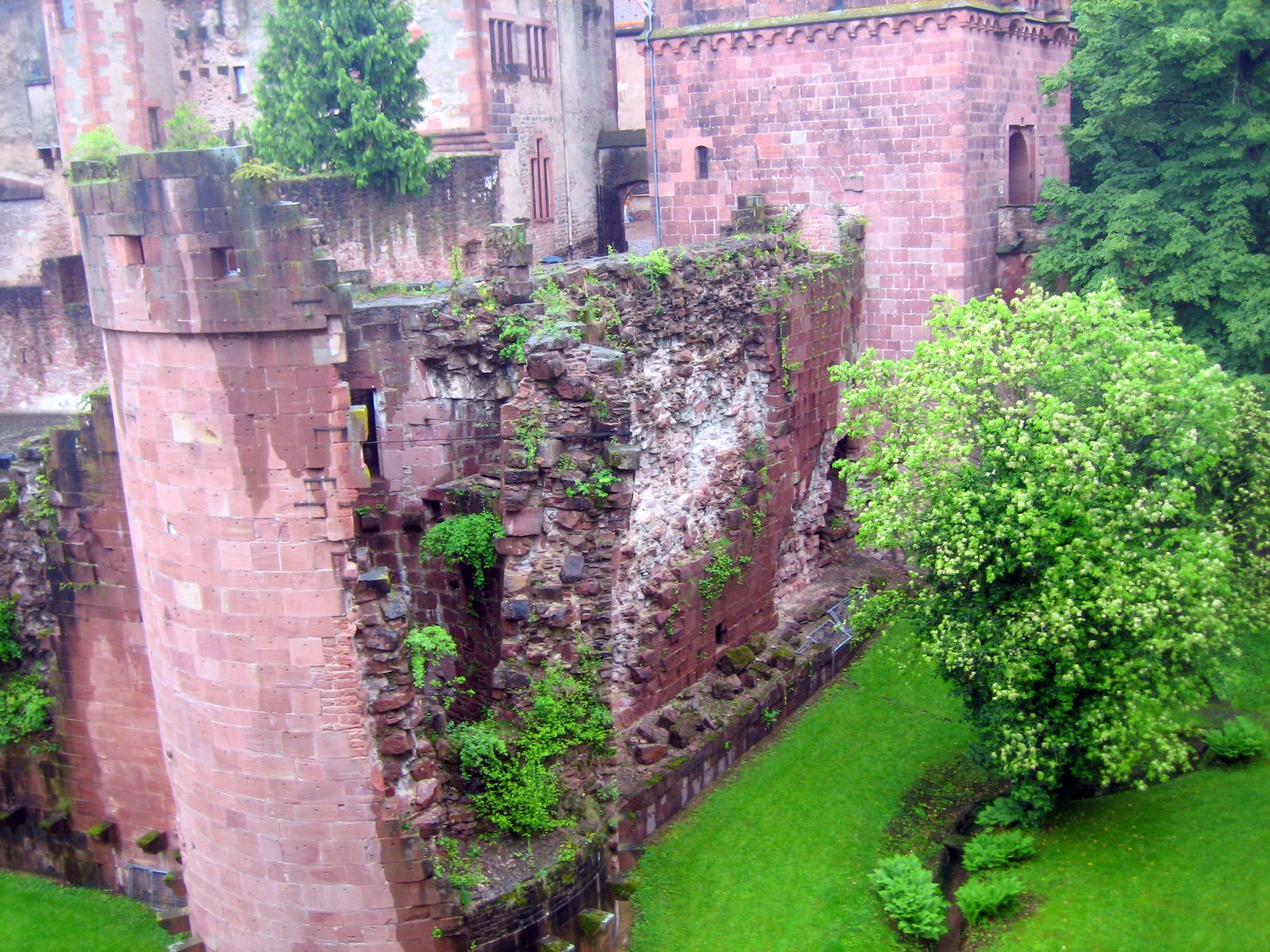
Heidelberg is fondly remembered for Sigmund Romberg's 'The Student Prince' but Anne's humming of the tune ' When its Summer time in Heidelberg' was at odds with pouring rain and lush green scenery. Spring is very late coming to Germany this year after an uncharacteristically long severe winter according to the locals. We completed our tour of the castle perched high above the city (312 steps for those keen on walking) which included an interesting visit to a nearby pharmacy museum. The museum provided a comprehensive display of medieval applications based upon the premise of the 4 humours; body, blood, phlegm and black and yellow bile. Depending whether or not you were in balance and having regard to the stars and seasons dictated the treatment to add or detract in such a way to restore equilibrium.
After returning to our boat the weather improved as we left the narrow Main river to enter the busy Rhine and our next port of Rudesheim whose 10.000 inhabitants receive 3,000, 000 visitors each year. We enjoyed a cable car ride up to Niederwald recreational area for a view over the sloping vineyards onto the city located on the opposite bank and land which extends on for a further 200 Km annexed to Germany following the defeat of the French. The impressive Monument erected on the site celebrating German unification in 1871 stands proudly 114 feet tall.
Cruising the Rhine in the afternoon we passed by 56 castles and the dangerously shallow and narrow section known as Lore - Ley which prompted this poem by famous German poet Heinrich Heine. Heinrich Heine
The Lore-Ley
I know not what it should imply, that I am so forlorn;
A tale from times so long gone by
From my thoughts will not be torn.
The air is cool and it darkens,
And the Rhine does calmly flow;
The peak of the mountain sparkles In the sinking sun's last glow.
The most beautiful maiden so alights,
But wondrously up there.
It blazes, her golden bow, She combs her golden hair.
She combs it with golden comb
And thereby sings a song;
A seeming wonder-tome
With a melody violent-strong.
The seaman in his tiny yacht
It grasps with wilding woe,
He looks not at the rock-reefs as he ought,
He looks only up from below.
I believe the swells do devour,
In the end, both skipper and skiff;
Smitten, in his final hour, By the Lore-Ley with her riff.
-- translated Robert Clarke, 2001
Subscribe to:
Posts (Atom)